While I strongly identify myself as a reader, I somewhat embellish my identity as a runner. Sure, I make every effort to run (or jog/walk) at least three times a week. However, I'm definitely not what I would consider to be a proficient runner. As I was huffing and puffing along this morning, I began thinking about my students.One of my favorite things to do is to listen to my students read a book to me and see the pride and joy on their faces. I am especially excited to have a beginning reader share an experience of reading a whole book to me. It's one of the greatest things I get to witness as a principal. As I was thinking about all of this, I began to hit a wall in my running. My inner self began to tell me that I couldn't run any further, it was just too hot and too tough to keep going. I quickly tried to shut myself up and began visualizing myself running to the next landmark (which just happened to be a fire hydrant that looked like it was miles away). I told myself I could do it and kept moving forward. After all, I had great success running a 10K last weekend and knew I could successfully make it if I just kept going and didn't give up. As I pushed ahead, I thought about how some of our students must feel when they are learning to read or working to reach that next stage of reading success and come to that point--the one where those inner negative voices in their heads try to creep up and tell them that they can't move forward. What was it that was allowing me to continue on even though I felt like I couldn't breathe and my legs were made of lead?
Setting goals, preparation, and practice are three things that I feel have really helped me be a more successful runner, and they can also help our students become more successful readers.
Setting Goals
I have been working hard to get back into running shape for several months now. I have put in the time at least 3 days a week to move my body and build my endurance. As I run, I set goals for myself by visualizing myself meeting a specific landmark or mile marker and then setting my sights on the next one. Setting mini-goals like this helps me conquer distances little by little, thus allowing me to run further than I thought possible. For our readers, it is also important for them to set goals based on their progress that will allow them to experience success and keep moving forward in their learning. They need to feel small victories in order to keep reading!
Preparation
I am conscious of hydrating my body and have been drinking plenty of fluids to be sure I don't cramp when out in this heat. I have many different preferences for hydrating my body--water, various flavored sugar-free sports drinks, coconut water, etc. No one forces me to drink just one type of fluid; I get to choose. Our young readers should also be allowed to choose what they "hydrate" with or "consume" as readers. Choice is an extremely important element in getting our students excited about reading. While we can definitely steer them in the right direction by exposing them to high-quality read-alouds, teaching them how to identify "good-fit" books, and making sure there is an abundant selection of books for them to choose from, we ultimately need to let them choose their flavor of "hydration" in order for them to keep moving as readers. If we are not allowing our readers to choose books that will quench their thirst, we are setting them up for defeat.
Practice
As a runner, the only way I have been able to increase my stamina is through practice. If I don't do it, I can't do it. The same holds true for our students. As educators, it is our responsibility to ensure that all of our students have time to read independently each day. At our school, there is an expectation that all students have a minimum of 20 minutes of independent reading time built into their day. We have been pretty successful with this as we implement a structure for our reading block called The Daily 5. It allows us to train our students to build their stamina and devour books when it is time to read independently. We also use dismissal time as one of those Reading in the Wild opportunities. At our school, the dismissal process takes about 30 minutes due to loading one bus at a time as it arrives. While this may seem inconvenient to some, it is actually a great opportunity for us to have our students squeeze in some more independent reading time. We have baskets of books available in our atrium area where our car riders are waiting as well, so that they are also able to squeeze in some reading while waiting for their parents to pick them up. All of this practice helps build fluency, comprehension, and reading habits that will assist our students with their reading endurance.
Just like learning to run, learning to identify oneself as a reader is a marathon, not a sprint. If we don't assist our students by supporting them with proper training, they may give up. I identify myself as a runner because it is something I do on a regular basis and something I enjoy. I want all of my students to identify themselves as readers and become avid consumers of the written word because it is something they do and enjoy. I don't want this to be an embellished identity, I want them to have true reading identities. As we prepare to welcome back all of our students in just a few short weeks, it is important to remember that we can help make this happen for our students. We can do this by helping them set reading goals and supporting them with the instruction to reach those goals, by helping them select books that interest them, and by giving them time to practice. Let's help prepare our students for a lifetime marathon of reading and help them truly become the readers that lie within.
Friday, July 10, 2015
Saturday, January 11, 2014
Effective Report Card Comments
Though hard to believe, the first semester of the 2013-2014 school year is over. Last week, we sent our second round of report cards home with our students. As I reviewed our students' report cards, my main objective was to review the teachers' comments. As an administrator, that is the most useful information to me when I'm looking at a child's progress report. Sure, the grades/standard ratings are important, but I find much more value in the written feedback provided by the teacher.
Comments provide an opportunity for teachers to give an overall "big picture" of a child's progress. When I read report card comments, there are several things that I believe are essential in determining the strength of the teacher's feedback. In addition to looking for the proper use of grammar and that the comments are free of spelling errors, the following items are "must-haves" in my opinion.
- Comments should begin with a positive statement. I believe all parents want to feel like their child's teacher has a good relationship with their child, and beginning with a positive statement sets the tone for parents to be receptive to the feedback.
- Comments should include specific strengths the student has exhibited during the grading period. For example, the student may have improved in reading, but instead of simply stating, "John improved in reading this quarter," I want to know what his specific improvements were. "John improved in reading fluency (which is the rate at which a person reads and the expression that is used while reading). His reading rate this quarter improved from being able to read 20 words per minute with proper expression to 45 words per minute."
- Comments should include specific challenges or areas of need. Rather than reading, "John is struggling with reading," I would prefer to have the teacher be a bit more descriptive. "John is struggling with reading comprehension (understanding what he reads). After reading, when asked "wh" questions such as who, what, when, where, and why, he often struggles with recalling the information from the text." A statement like this leads right into the fourth item I look for when reading report card comments.
- Comments should include specific goals/next steps for the student. Using the statement from above regarding John's struggle with reading comprehension, the teacher could set a goal. "Next quarter, John's reading goal will center around improving his comprehension by using the strategy of checking for understanding. I will meet with him frequently to help him practice this strategy during reading and document his progress."
- Finally, I look for the feedback to be as jargon-free as possible. When using educational vocabulary or abbreviations such as WPM, fluency, comprehension, etc., it is important to explain what these terms mean. Not all parents are educators. Therefore, they may not have the background knowledge to decipher some of the terms that we, as educators, use on a daily basis.
I appreciate the amount of time and effort that all elementary teachers put into providing effective feedback on their students' report cards. As a former second grade teacher, I recall the hours spent writing comments each quarter. And, while it does take some time to provide effective feedback, it is time well-spent. Not only are parents more informed about their child's progress, the students' future teachers also have a road map of progress that they can use as reference. As we get busy with instruction during the third quarter of the school year, it is exciting to me to think about all of the progress our students will make. I can't wait to read all about it in March!
Thursday, January 2, 2014
One Word: Commitment
"Every New Year, 87% of adults--more than 206 million people--create new goals and resolutions, only to experience the same frustrating results: false starts and failures. In fact, 50% of resolution makers will fail by the end of January." This is an excerpt from One Word That Will Change Your Life, by Dan Britton, Jimmy Page, and Jon Gordon. I recently read this book, and I have to admit that I have been on the failing end of several New Year's resolutions. I really do enjoy this time of the year--the beginning--where we get the chance to "start again" so to speak. However, my resolutions usually begin like gangbusters and then quietly sneak off to the never-world. This year, I needed to seek something different, so I downloaded the aforementioned book, and I have to say that I was instantly hooked.
The authors share with their readers their personal journeys and how the selection of "one word" to live by is a much more attainable goal. They share how powerful words can be--"they have the power to inspire, encourage, appreciate, heal, and turn the impossible into the possible." So, could I really do this--choose just one word to sum up an all-encompassing goal I have for myself in this new year? I took the authors' advice and followed their three-step process:
1. Prepare your heart by looking in.
2. Discover your word by looking up.
3. Live your word by looking out.
What I discovered along the way is that there are many powerful words out there that I could choose for myself. How on earth would I know which word was my word? I began a list of words that I felt were things I wanted to achieve in the new year--strength, health, fitness, energy, motivation, action, willpower, commitment...
On the morning of January 1, as my husband and I were watching the Today Show, I was stunned to see Jon Gordon introduced and a segment about One Word appear before my eyes! My husband thought I was crazy, because I shouted, "Oh, that's the book I just read! I was planning to do this!" I guess there was no turning back now--I HAD to select my "one word." I needed to commit!
Funny how the word found me! I ended up not choosing it so much as it chose me. Commitment. There it is. In 2014, I look forward to all of the ways I can show my commitment. First and foremost, I am committing to this word! It is my word, and I'm going to own it. What word will define you in 2014?
Check out the "One Word" website for additional resources. http://getoneword.com/
Tuesday, December 31, 2013
PLN Blogging Challenge
Most of you have probably seen the blog challenges going around on Twitter. Some have been called the Sunshine Award, the Homework Meme, etc. I haven't really paid much attention to those little chirps until now.
"Tag, you're it!" was the message that popped up on my iPad, alerting me that I had received a tweet. Thank you, Jessica Johnson, for "tagging" me and motivating me to dust off the old keyboard. It's been quite awhile since I've taken the time to sit down and write anything on my blog. 2013 brought many changes for me--as you will soon read below. Hopefully I will be able to get back into the rhythm of writing in 2014. This challenge may have been just what I needed to kickstart the process!
The rules of the challenge
"Tag, you're it!" was the message that popped up on my iPad, alerting me that I had received a tweet. Thank you, Jessica Johnson, for "tagging" me and motivating me to dust off the old keyboard. It's been quite awhile since I've taken the time to sit down and write anything on my blog. 2013 brought many changes for me--as you will soon read below. Hopefully I will be able to get back into the rhythm of writing in 2014. This challenge may have been just what I needed to kickstart the process!
The rules of the challenge
- Acknowledge the nominating blogger. (Thanks again, Jessica!)
- Share 11 random facts about yourself.
- Answer the 11 questions the nominating blogger has created for you.
- List 11 bloggers. They should be bloggers you believe deserve some recognition and a little blogging love!
- Post 11 questions for the bloggers you nominate to answer and let all the bloggers know they have been nominated. (You cannot nominate the blogger who nominated you.)
11 Random Facts About Me
1. I am a newlywed. My husband, JD, and I recently got married in Las Vegas. We are very happy!
2. I recently received the first stamp on my passport as I traveled outside of the U.S. for the first time in my life. We visited Aruba for our honeymoon. If you have never been there, I would highly recommend it. The weather is perfect--88 degrees and sunny every day.
3. I have four children--3 sons and 1 daughter, ages 26, 24, 22, and 19. Three of whom I've called my own since birth and one recent addition via marriage.
4. In 2013, I moved from Indiana (where I had lived my entire life) to Georgia. My husband is from Georgia, and we decided that we were going to make our home there. In the process, I resigned from an elementary principal position in Indiana that I absolutely loved. I was very anxious about finding a new position in Georgia, but as it turns out, I found another position that I love very much as well! I am the proud principal of Bethlehem Elementary in Bethlehem, GA. As my mother told me as I was preparing for the job interview-- "Good things happen in Bethlehem." Mom--you were right!
5. I was a late bloomer. I began my college career as a 25-year-old mother of three. I went to school full time and was blessed to have my amazing mom help care for my kids while I attended classes. It was very rewarding to have my family in attendance as I walked across the stage to receive my degree.
6. In keeping with the late bloomer theme, I got my first teaching position at the age of 30. I taught fourth grade for two years before transferring to another elementary in which I taught second grade for six years. Another fun fact: The first year I taught fourth grade, my oldest son was in fourth grade, and the first year I taught second grade, my daughter was in second grade. (They attended a different elementary school.)
7. I never really planned on becoming a principal. I absolutely loved teaching and thought that I would always be in the elementary classroom. Through opportunities to serve as a teacher leader, I found that I had a real passion for instructional leadership. With some encouragement from the people around me, I enrolled in a Master's Degree program and ended up landing an assistant principal position before I had even finished my degree. After three years as an assistant, I landed my first principal position. I can't imagine being anything but a principal now! (Although, I will ALWAYS consider myself a teacher.)
8. I would love to write a book. I am not sure what type of book I want to write yet, but I know when the time is right I will know what I am supposed to write. Right?
9. I love to read. My parents instilled this in me right from the very beginning. I can remember many read alouds, and my mom still has some of my favorite childhood picture books memorized from reading them so many times. While I kind of lost the love of reading for most of my middle school and high school years, I know that it was their love for books and reading and the solid foundation they had set that brought me back to something I dearly love. When my husband and I were recently with my parents for the holidays, we watched my dad soar through a new James Patterson novel in one sitting. Needless to say, my husband knows where I get it from now!
10. It is my goal to run the Peachtree Roadrace in Atlanta in July. There. I needed to see that in print.
11. I recently saw my celebrity crush in concert, and I am not ashamed to admit that I screamed and carried on like a teenager. It was three hours of pure bliss!
Now, to answer the questions that Jessica posed.
1. What is your favorite tv show? New Girl, SportsCenter
2. What is one app or resource you’ve learned about on Twitter that has been a game changer for you at work? I can't really narrow this down to one resource since I believe Twitter has made me a better principal overall. The resource that I find most valuable? The people in my PLN. I have learned so much from them and carry that with me into school each day.
3. What is your typical bedtime? I'm usually in bed by 10 or 10:30, but I've been known to be in bed by 9:00 if I'm really tired.
4. Best book you’ve read in 2013? Tough question! Can't narrow it to just one, so here are a few of my favorites of the year: Allegiant (Divergent Trilogy), Requiem (Delirium Trilogy), Navigating Early, Reading in the Wild
5. Favorite Twitter Chat: #satchat and #titletalk
6. Best place you’ve vacationed? Aruba
7. How has your PLN impacted you? I have taken many of my PLN's great ideas back to school with me as a springboard for improvement or inspiration. When I'm in need of an "educational pick-me-up", all I have to do is click on the little blue and white birdie on my ipad or phone and my PLN is there to help with anything I might be searching for.
8. What motivates you each day to be an educator? The students and teachers motivate me each day. I go to work each day eager and ready to learn, and I want my students and teachers to feel the same way. Feeling like I have the opportunity to make an impact on any one of the hundreds of lives in my building each day is very rewarding.
9. What was the most amazing lesson you ever facilitated or observed? I'm going to "ditto" Jessica on this answer. She wrote, "I’m always amazed when I see my teachers leading mini-lessons in reading/writing during the Daily 5 block. I wish I could go back in time and teach that way, because it’s so much more engaging and student centered than how I taught." I feel the same way. I wish I would have been able to implement this in my classroom. I am always in awe when I see it working the way it is meant to! (I would also have to add that observing Ron Clark teach a lesson at the Ron Clark Academy was a pretty amazing experience, too!)
10. If you had a whole day to do just what you wanted, what would it be? Spend time with my family
11. Favorite tv show when you were growing up? American Bandstand, The Brady Bunch, The Bionic Woman, Little House on the Prairie (Dating myself here....)
Join the Challenge:
The same questions are posed to the following 11 bloggers. Who's up for the challenge?
2. Chris Lehman
3. John Schu
4. Colby Sharp
7. Sherry Gick
10. Tony Sinanis
11. Matt Wachel
Thursday, November 14, 2013
Teach Like a Pirate Day
We embraced Teach Like a Pirate Day on October 23. As a part of our book study, groups of teachers had to perform skits and teach the rest of the staff about their assigned letter/word from the book. They did not disappoint!
| Pre-K Pirates |
| Kindergarten Pirates |
| 3rd Grade Pirates |
| 4th Grade Pirates |
| 5th Grade Pirates |
We have challenged our staff to continue to keep the PIRATE spirit alive in their lessons each day! Aarrrgh!
Wednesday, October 9, 2013
Channel Your Inner Pirate! Arrgh!
Today, my assistant principal and I channeled our inner pirates as we led our staff through what they thought was going to be a session on critiquing instruction. We began the session by telling the staff that as we have been doing our walk-throughs, we have been assessing their instruction. We thought it would be a good idea to give them some practice in doing the same. We had three short video clips for them to watch. They were asked to look at what each teacher was doing, what the students were doing, the level of engagement, etc. and be ready to critique it.
After all three video clips were shown, we instructed them to have a conversation with those around them about what they observed. As they began their discussion, we escaped and ran to our offices to put on our costumes! We transformed into pirates and rejoined the group.
We entered the cafeteria and spoke in our best "pirate-ese" as we told the staff that we hoped we wouldn't see any of that type of teaching happening here. If so, they may have to "walk the plank." We then decided to share our treasure with them--a copy of Teach Like a Pirate by @burgessdave. Inside each book, we had placed a paper with one letter of the word PIRATE on it. We did a jigsaw activity in which we had the staff move to sit with others who had the same letter. Their task was to read the part about their letter in the first section of the book and design a skit/performance that will teach the rest of the staff what their assigned letter stands for.
Passion
Immersion
Rapport
Ask and Analyze
Transformation
Enthsiasm
Two weeks from today, each group will have the opportunity to present their information in an engaging way.
And, one more thing.... It will be Teach Like a Pirate Day at our school! Teachers and staff are encouraged to dress up like pirates for the day. The response in the crowd when this was announced was great! Everyone seemed very excited about this opportunity. We are keeping it a secret so that we can surprise our students. I look forward to sharing how our staff teaches what each letter represents. Here's to channeling our inner pirates! Arrgh!
![]() |
| Click below to watch on Teacher Tube |
After all three video clips were shown, we instructed them to have a conversation with those around them about what they observed. As they began their discussion, we escaped and ran to our offices to put on our costumes! We transformed into pirates and rejoined the group.
| Arrgh! We shared our treasure with the staff! |
We entered the cafeteria and spoke in our best "pirate-ese" as we told the staff that we hoped we wouldn't see any of that type of teaching happening here. If so, they may have to "walk the plank." We then decided to share our treasure with them--a copy of Teach Like a Pirate by @burgessdave. Inside each book, we had placed a paper with one letter of the word PIRATE on it. We did a jigsaw activity in which we had the staff move to sit with others who had the same letter. Their task was to read the part about their letter in the first section of the book and design a skit/performance that will teach the rest of the staff what their assigned letter stands for.
![]() |
| A Must Read for Teachers! |
Passion
Immersion
Rapport
Ask and Analyze
Transformation
Enthsiasm
Two weeks from today, each group will have the opportunity to present their information in an engaging way.
And, one more thing.... It will be Teach Like a Pirate Day at our school! Teachers and staff are encouraged to dress up like pirates for the day. The response in the crowd when this was announced was great! Everyone seemed very excited about this opportunity. We are keeping it a secret so that we can surprise our students. I look forward to sharing how our staff teaches what each letter represents. Here's to channeling our inner pirates! Arrgh!
Friday, October 4, 2013
Looking for the Good in Every Day: A Lesson from Pete the Cat
![]() |
| Rockin' in Our School Shoes during 2013 Reading Parade |
I am a huge Pete the Cat fan. Recently, I purchased a copy of Kimberly and James Dean's Pete the Cat and His Magic Sunglasses. Pete, a rockin' character we have come to know and love has the "blue cat blues." Grumpy Toad lends him some magic sunglasses that help Pete see things in a whole new way. Throughout the story, Pete meets other friends who are sad, mad, and frustrated. He lends them his sunglasses and helps them see the brighter side of things. When Pete breaks his sunglasses, it is the wise old owl who reminds him that he doesn't need magic sunglasses to see things in a new way, he just needs to look for the good in every day.
At this point in the school year, educators can be feeling the blues as well. Wrapping up the first quarter of the school year is such a busy time. Many demands are being placed on teachers, and their energy is being zapped. Report cards, parent-teacher conferences, assessments, data team meetings, and many other things are in full swing at the moment. It can become overwhelming--but only if we let it. As the wise old owl reminds us, we need to continue to look for the good in every day. We don't need magic sunglasses, we just need a positive attitude. When we consciously choose to focus on the positive, how can our days be anything but AWESOME?
Monday, August 26, 2013
Teamwork: Untangling the Human Knot
| 4th Grade Teamwork |
Our instructional coach facilitated a team-building activity during last week’s Professional Learning Community meetings. Each grade level team was charged with the task of untying the Human Knot. As the teams of teachers worked together to get untangled, teamwork was evident. There was cooperation, communication, and a few laughs along the way. When discussing the activity afterward, each team recognized that it takes all of them working together to solve a problem. Here are a few of their comments. “This helps us see the big picture and that it is not always all about me.” “We worked together to squeeze through uncomfortable situations to get to where we needed to be.” “We had to listen to each other, communicate, and take risks.” “We had to persevere and keep trying things out.” “We had to trust each other.” As our grade level teams embark on the school year, it will be critical for them to keep these values at the forefront of their working relationship. It is also vital that they build this same sense of community, cooperation, and teamwork in their own classrooms.
Saturday, July 20, 2013
Running, Reading, and Building Stamina
Today I decided to "get off the couch" and begin moving again. I have taken some time off from running and working out, and I am really starting to feel the effects. In knowing that I need to re-energize myself and increase my overall well-being, I began the Couch-to-5K program today. I have the app installed on my phone, and I've used the app at various times to ease back into this thing called "running." As I was in the midst of one of the running intervals, I began to think about how our students will also be getting back into a thing called "reading" when they begin school in just a few short weeks. Chances are they have not done much reading over the summer and will be in a situation much like mine in which they are, in a sense, starting over.
As I ran, I had some of my favorite music playing. I got to choose the songs I had in my playlist, and they were from many different genres. Most of the songs were songs I have played again and again and know by heart. A few of them were newer songs that I just added this morning. This got me thinking about how important it is to allow our students to choose their own reading material, even when they choose books they may have read multiple times. Of course we don't want them to always choose the books they have previously read, but if we take the time to allow them to "build their playlist" by adding a variety of books to their book boxes, they will have many options. My music motivates me because it is something I enjoy, much like the books our students enjoy motivate them and can be the impetus for them to continue reading. Let's remember to take the time to help our students build their personal playlists--good-fit books from a wide variety of genres.
If you are not familiar with the C25K program, it is an incremental program that alternates running and walking in increments that gradually increase throughout the program until you are running the entire time. The app has a voice-over that will tell you when to walk and when to run. Just knowing that that voice would be coming back on and telling me I could walk was a motivator for me as well. I knew that I only needed to make it just a little bit further before I could take a bit of a break and walk. The program is allowing me to take baby steps in increasing my endurance. The same holds true for our students. We should not expect them to be able to sit and read for 20-30 minutes straight right out of the gate. They need to have increments in which they read, take a break, and read again in order to increase the amount of time they will be able to attend to the task. As teachers, it is our job to be sure that we allow for this critical build up of endurance and give our students the chance to take a breath every now and then.
The app also allows you to keep track of your time per mile and distance and has a journal feature that allows you to make anecdotal comments about the run. This has always been a very motivating factor for me. I am a very competitive person and like to challenge myself and see if I can improve from session to session. We can do the same for our students. Charting their stamina by the number of minutes they were able to read and allowing them to see their gains is also another way we can motivate our students and allow them to see their small successes gradually building into more and more time they are able to read without taking a break.
Soon, we will begin the school year and begin the journey of reading with our students. I hope all educators will remember that we will need to support our students in building their reading stamina. If we take the time to help them do this in the beginning, we will have them "reading marathons" in no time.
As I ran, I had some of my favorite music playing. I got to choose the songs I had in my playlist, and they were from many different genres. Most of the songs were songs I have played again and again and know by heart. A few of them were newer songs that I just added this morning. This got me thinking about how important it is to allow our students to choose their own reading material, even when they choose books they may have read multiple times. Of course we don't want them to always choose the books they have previously read, but if we take the time to allow them to "build their playlist" by adding a variety of books to their book boxes, they will have many options. My music motivates me because it is something I enjoy, much like the books our students enjoy motivate them and can be the impetus for them to continue reading. Let's remember to take the time to help our students build their personal playlists--good-fit books from a wide variety of genres.
If you are not familiar with the C25K program, it is an incremental program that alternates running and walking in increments that gradually increase throughout the program until you are running the entire time. The app has a voice-over that will tell you when to walk and when to run. Just knowing that that voice would be coming back on and telling me I could walk was a motivator for me as well. I knew that I only needed to make it just a little bit further before I could take a bit of a break and walk. The program is allowing me to take baby steps in increasing my endurance. The same holds true for our students. We should not expect them to be able to sit and read for 20-30 minutes straight right out of the gate. They need to have increments in which they read, take a break, and read again in order to increase the amount of time they will be able to attend to the task. As teachers, it is our job to be sure that we allow for this critical build up of endurance and give our students the chance to take a breath every now and then.
The app also allows you to keep track of your time per mile and distance and has a journal feature that allows you to make anecdotal comments about the run. This has always been a very motivating factor for me. I am a very competitive person and like to challenge myself and see if I can improve from session to session. We can do the same for our students. Charting their stamina by the number of minutes they were able to read and allowing them to see their gains is also another way we can motivate our students and allow them to see their small successes gradually building into more and more time they are able to read without taking a break.
Soon, we will begin the school year and begin the journey of reading with our students. I hope all educators will remember that we will need to support our students in building their reading stamina. If we take the time to help them do this in the beginning, we will have them "reading marathons" in no time.
Friday, May 31, 2013
180 Book-A-Day Challenge
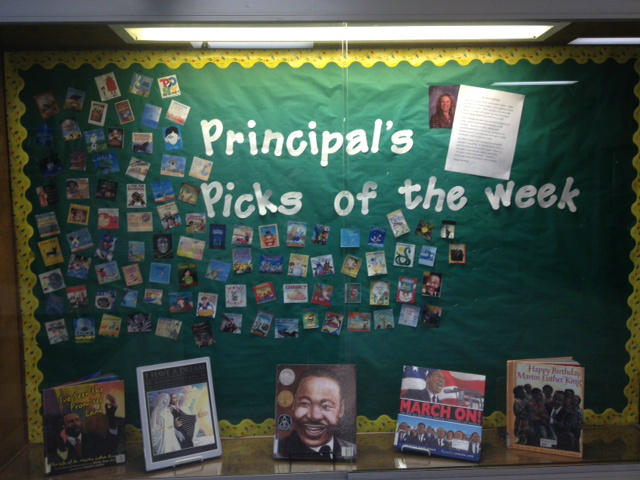
This school year, I participated in a "180 Book-A-Day Challenge." My goal was to read one children's book for each day students were in school. As I read the books, I displayed my "Principal's Picks of the Week" in the main hall in our display case and posted images of all of the books I had read. I also promoted the books I had read the previous week on the Monday morning announcements. Students were able to turn in book recommendations to me, and I selected one student each week to appear on the announcements with me to promote the book he or she had recommended.
Those of you who have visited my blog know that my goal this school year was to become the lead reader at Mayflower Mill. This challenge allowed me to successfully meet that goal. It also caused reading to become contagious in our building. Not only were students reading like crazy, they were also recommending books to me. As I would pass a student in the hall, he or she would say, "Hey, Ms. Higgins, have you read....?" My staff also caught the reading bug and began to ask me for recommendations and began borrowing books from me. I heard more teachers talking about what they were reading to their students and what they were reading for their personal enjoyment. Teachers began posting what their class was currently reading on their doors for passersby to view. Books and the culture of reading became visible and palpable entities that began to define us.
I never thought something as simple as this challenge and the intentional promotion of reading would do so much to foster a culture of reading in our building. However, I am proud to say that Mayflower Mill is now a community of readers. What could be more rewarding than that?
Principals and teachers, how have you promoted reading in your building? I'd love to get some new ideas for next year!
Those of you who have visited my blog know that my goal this school year was to become the lead reader at Mayflower Mill. This challenge allowed me to successfully meet that goal. It also caused reading to become contagious in our building. Not only were students reading like crazy, they were also recommending books to me. As I would pass a student in the hall, he or she would say, "Hey, Ms. Higgins, have you read....?" My staff also caught the reading bug and began to ask me for recommendations and began borrowing books from me. I heard more teachers talking about what they were reading to their students and what they were reading for their personal enjoyment. Teachers began posting what their class was currently reading on their doors for passersby to view. Books and the culture of reading became visible and palpable entities that began to define us.
I never thought something as simple as this challenge and the intentional promotion of reading would do so much to foster a culture of reading in our building. However, I am proud to say that Mayflower Mill is now a community of readers. What could be more rewarding than that?
Principals and teachers, how have you promoted reading in your building? I'd love to get some new ideas for next year!
Wednesday, March 6, 2013
Read Across America
![]() |
| The staff participated in Read Across America Day theme--"Dr. Seuss Day." |
This year, our school celebrated Read Across America Day (also Dr. Seuss Day) by having two large group read-a-thons in the cafeteria/gym. There was a morning session and an afternoon session. Each session began with me reading aloud a Dr. Seuss book. I chose to read The Cat in the Hat Comes Back to the first group. The kindergarten students still think that Little Cats A-Z were in my hat! The second group was entertained with Oh the Thinks You Can Think!
![]() |
| Sharing a good book. |
We love to read at MME!
![]() |
| Spreading out to do some reading! |
Parent University
![]() |
| Over 400 members of our school community enjoy a meal together at Parent University. |
![]() |
| Parents become students during information sessions at Parent University. |
The first year of its conception had us running a large group event with breakout sessions specific to grade-level needs. The first events were attended by a small percentage of parents and only one or two teachers per grade level were present. Over the past two years, we have grown Parent University into an event that has regularly had 300-400 attendees with every teacher in our building being involved. How do we get families to come? We provide a meal which is paid for by our Parent Advisory Council. We also provide free daycare for families who have children younger than elementary age. We also not only have the parents in sessions learning about curriculum and instruction, but we have sessions for the students to come and do some fun learning activities. Then, parents and students get back together to do some learning together. It has been a recipe for success!
| Parents work with their children on research. |
The Parent University event we held in February drew over 400 people (parents and students combined). Our school community shared a meal and an evening of learning. These events not only keep parents informed of what their children are learning, they also solidify relationships between the home and the school. Our community comes together to show our students that school is important and enjoyable. Their presence at the events shows their children that they value what is happening in our school on a daily basis. My staff does an amazing job of providing parents with the tools they need to be more involved in their childrens' education through the design of high-quality information sessions. I am very grateful to have such a supportive school community!
Tuesday, January 29, 2013
Our Favorite Books in January
![]() |
| Staff photos of our favorite books read in January. |
What was your favorite book this month? As part of our focus on all things books and reading, I asked the staff to send me photos of themselves holding their favorite book from January. It could be personal, professional, a class read aloud--whatever book they enjoyed most.
![]() |
| We wrote short reviews for our January selections. |
After posting their photos on our staff classroom bulletin board, each person also wrote a short review to share with the group and then we posted them on our Read It and Rate It bulletin board.
My favorite book this month was Navigating Early by Clare Vanderpool. In this story, Jack, a young boy from Kansas is uprooted from his home in Kansas after the death of his mother. His father, who has been serving in the Navy during World War II, enrolls him in a boarding school in Maine. When Jack arrives at the boarding school, he meets an interesting character named Early Auden. What ensues is an adventure of epic proportions as Jack and Early seek to find answers to questions that have been haunting them. Early's story of Pi (the number 3.14....) adds a unique twist to the storyline. It is really hard to describe just how good this book is with a brief review. I hope you will add this to your "To Be Read" pile. It is sure to be an instant classic.
Sunday, January 27, 2013
A Week of Professional Learning in Review
This week, we continued to work on professional learning in the area of writing instruction. Teachers were asked to bring 2-3 samples of student writing to our meeting on Monday. They were then divided into cross-grade level teams of teachers from K-2 and 3-5. Each member of the group introduced each student's piece and read it out loud to their group. Then the rest of the group gave positive feedback and asked questions. We spent both Monday and Tuesday completing the review of student samples and reflected on what we had gained from the experience. On Wednesday, we reviewed a video clip of Lucy Calkins conferring with a young writer and critiqued it. We then explored the Reading and Writing Project's website resources. To end the week, I moderated a Tweetchat to discuss our learning. I have included the chat below. This was our 2nd Tweetchat of the year, and the first time I have used the Storify app to archive our discussion. I feel it was a very successful week of learning for us, and I plan to continue to incorporate social media into our professional learning on a regular basis.
Friday, January 11, 2013
What We Believe About Writing Instruction
This week, we continued building our repertoire of knowledge in the area of writing instruction. Taking a cue from Lucy Calkins we came up with a pseudo "Bill of Rights" regarding writing instruction in our school and listed our beliefs as a staff. As we continue to learn and grow, we may add some amendments, but for now this is what we all agreed upon. It is our hope to use our collective beliefs and efforts to create an environment in which our students will flourish as writers.
What
We Believe About Writing Instruction
· Writing
is a subject and should be taught every day.
· Students
should have time to practice writing in class each day.
· Students
should have a purpose/audience for their writing and frequent opportunities to
publish and share.
· Students
should learn a variety of genres/types of writing and have time to practice
them.
· Students
should be regularly exposed to mentor texts that highlight what good writers
do.
· Teachers
should structure their writer's workshop so there is time for whole group mini-lesson,
independent writing time that allows for student choice, conferencing, and sharing.
· Grade level teams
should collaborate on units of study and work together to gather resources,
create lessons and assessments, and follow the same general timeline for
instruction.
Tuesday, January 8, 2013
The Power of a Challenge

As of today, I am over half way through my 180 Book A Day
Challenge that began back in August. I
pledged to read one elementary level book for each day school is in session,
based on our school’s theme this year: “Today
a Reader, Tomorrow a Leader.” Born from that challenge I have been promoting
the books I read on the morning announcements.
I have somewhat slacked from that job as of late, but with the new
semester, I am pledging to get back to my regular appearances. I have been keeping track of my books by
printing small images of each book I read and posting them on a bulletin board titled,
“Principal’s Picks of the Week” in our main hallway. The five books I am reading that week or the previous
week are also displayed for all of the students to see.
So what have I gained by taking part in this challenge? One thing I have most definitely gained is a
deeper knowledge about children’s books.
Not only do I have better knowledge of the books that are available in
our school library, I also have a greater knowledge of children’s literature in
general. I hate to admit it, but before
this challenge, the only Sharon Creech book I had read was A Fine, FineSchool. I had no idea she had written such
beautiful, and now much-loved, novels such as Walk Two Moons and RubyHoller. If not for my challenge, I may
have never discovered this! That would
have been a huge tragedy, indeed! I may have
never discovered that the world of non-fiction picture books has really
expanded and changed in the past decade to include such beautiful books as
Balloons Over Broadway by Melissa Sweet or that graphic novels are now all the rage with
Jenni and Matt Holm's characters Baby Mouse and Squish leading the charge!
I have also gained a school community of readers as a result
of this challenge—a community to which I belong and feel very much a part
of. Students recommend books to me or
say, “Ms. Higgins, have you read….?” I
feel confident in telling a student I think he would really enjoy Fake Mustache
by Tom Angelberger—BECAUSE I HAVE READ IT! Another bonus is that my staff is also part
of this community and we now talk more with each other about the books we are
reading—be it for school or in our personal lives. Divergent and Insurgent by Veronica Roth have
been making the rounds among the teachers (one of my favorite series that is not part of my school challenge, by
the way), and many of them have also read Wonder by RJ Palacio and Matched by
Ally Condie. One of the greatest gifts I received this holiday season was
from one of my teachers who wrote a letter to me, from her heart, and then
attached a list of book recommendations.
Has that ever happened before?
No! Why now? Because I am projecting my love of books into
my school community and showing them that books have the power to connect us
all.
This challenge has connected me with my students and staff in
ways I never imagined, and I look forward to completing the second half of the
adventure. What books would YOU
recommend I read?
Subscribe to:
Posts (Atom)


.jpg)